The legal clock is ticking for enterprise software.
With recent updates to Title II of the ADA, government agencies are legally mandated to ensure their software vendors meet WCAG 2.1 Level AA accessibility standards. Suddenly, clients are running WAVE tools on massive, legacy enterprise platforms — and the results highlight the reality of software that has evolved over decades.
Our core platform is a hybrid beast: legacy ASP.NET WebForms providing the business logic, wrapped inside a modern Angular 20 shell. Doing a manual, file-by-file WCAG remediation across thousands of files would take months of developer time we simply don't have.
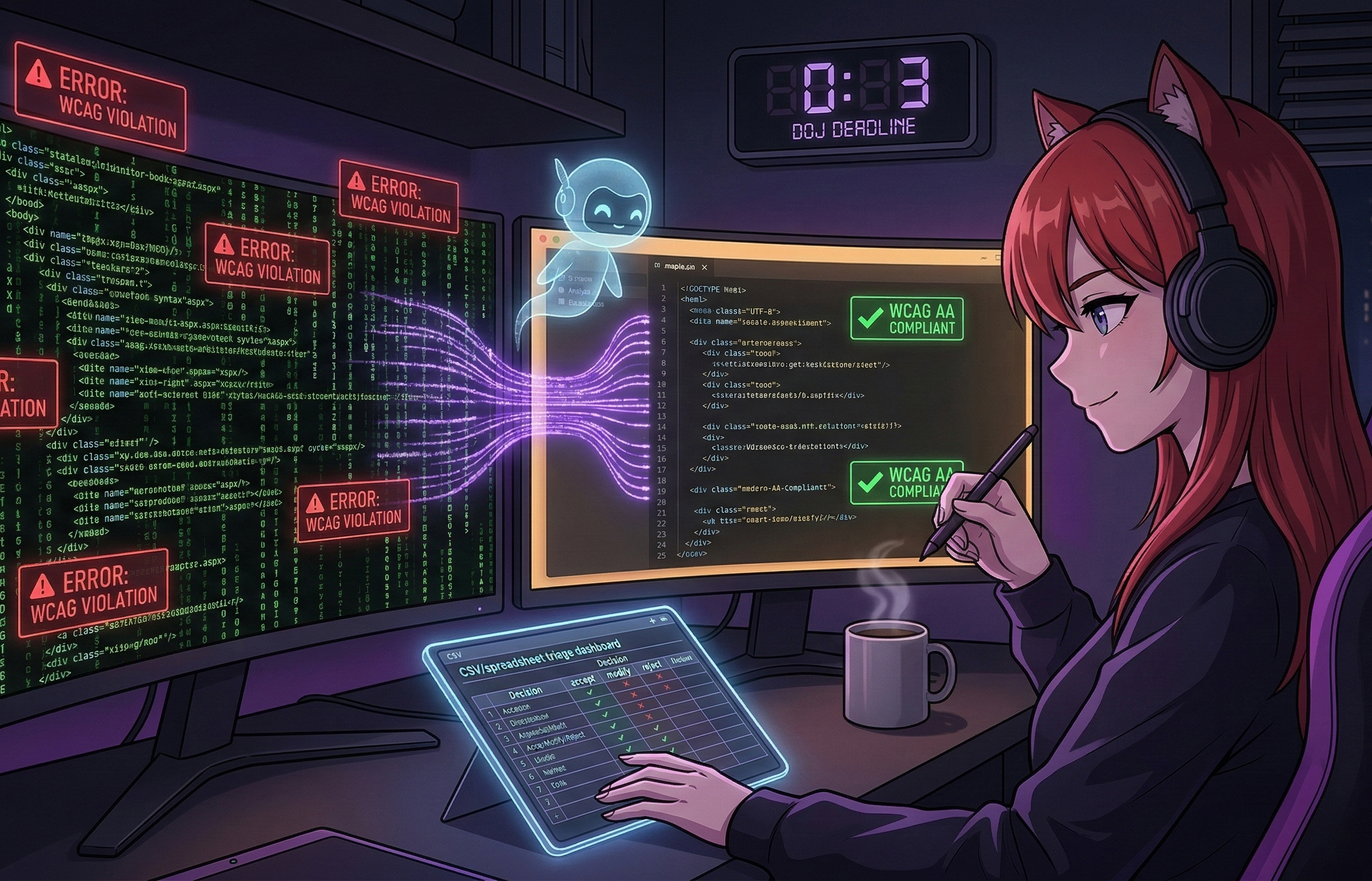
The Vision & The Mission
My boss had a vision: Could we use AI to automate this remediation?
I was tasked with proving it. Getting buy-in from Product and Dev Managers to shift roadmaps is incredibly difficult unless you can show them it works. So, I fired up my IDE, teamed up with my AI coding agent (Kiro), and started building functional prototypes of a remediation engine to prove this was feasible.
Step 1: Don't Boil the Ocean (The Pilot Module)
You can't point an AI at a 20-year-old enterprise codebase and say "fix it." It will hallucinate, break the build, and terrify the Dev Managers.
Instead, I used Kiro to help me script a highly targeted Node.js CLI prototype. We scoped it down to a single, 6-file pilot module. The CLI bypasses the browser entirely, parsing the raw .aspx markup on disk to hunt for missing ARIA labels on custom server controls.
Step 2: The "Human-in-the-Loop" Sell
The secret to getting Dev Manager buy-in isn't full automation; it's safe automation.
I prototyped a workflow where the AI suggests fixes based on surrounding markup, but outputs everything to a clean CSV rather than committing code.
- Scan: AI finds the issue and suggests a contextual fix (e.g., guessing the right aria-label).
- Triage: A UX designer reviews the CSV, making the final call to accept, modify, or reject the AI's suggestion.
- Apply: The CLI ingests the reviewed CSV, patches the source files directly, and creates automatic backups.
In our first pilot, we found and fixed over 140 ARIA issues in minutes, with a human maintaining 100% control over the final output.
The Takeaway
When faced with massive, legally-mandated tech debt, AI is the perfect prototyping partner. By using an agent to quickly build a targeted, human-in-the-loop CLI tool, we are moving from a theoretical "maybe AI can do this" to a tangible proof-of-concept we can put in front of stakeholders.
Up next in Part 2: How I'm prototyping an Angular triage dashboard to scale this from a single module to the entire enterprise.